





16 Nov ChatGPT Meal Planning for the Holidays: A Plan That Fits Your Kitchen
Posted at 13:00h
in ChatGPT for Everyday Life, General News & Updates from Kevin Wallace & The NewLife Portal
The menu’s the easy part. Turkey, stuffing, sweet potatoes, green beans, and something good for the vegetarian at the table. Or whatever your tradition is. You could write that list in your sleep, and you don’t need ChatGPT meal planning to do it.
The hard part is the timing. It seems like every recipe wants the oven at a different temperature, all at the same time, and you’ve only got one oven. That’s where ChatGPT meal planning can really help. You just have to give it your real kitchen to work with, and then read what comes back like you’re the one who has to cook it.
Why holiday meal plans fall apart
Every recipe is written on its own, like it has the whole kitchen to itself. But on the holiday itself, your kitchen has to cook all of them at once. You’ve got one oven, a few burners, limited counter space, and people showing up at a set time.
A plan that ignores all that can look fine on paper. Then around 1 p.m. on the big day, it falls apart.
Start ChatGPT meal planning with your real kitchen
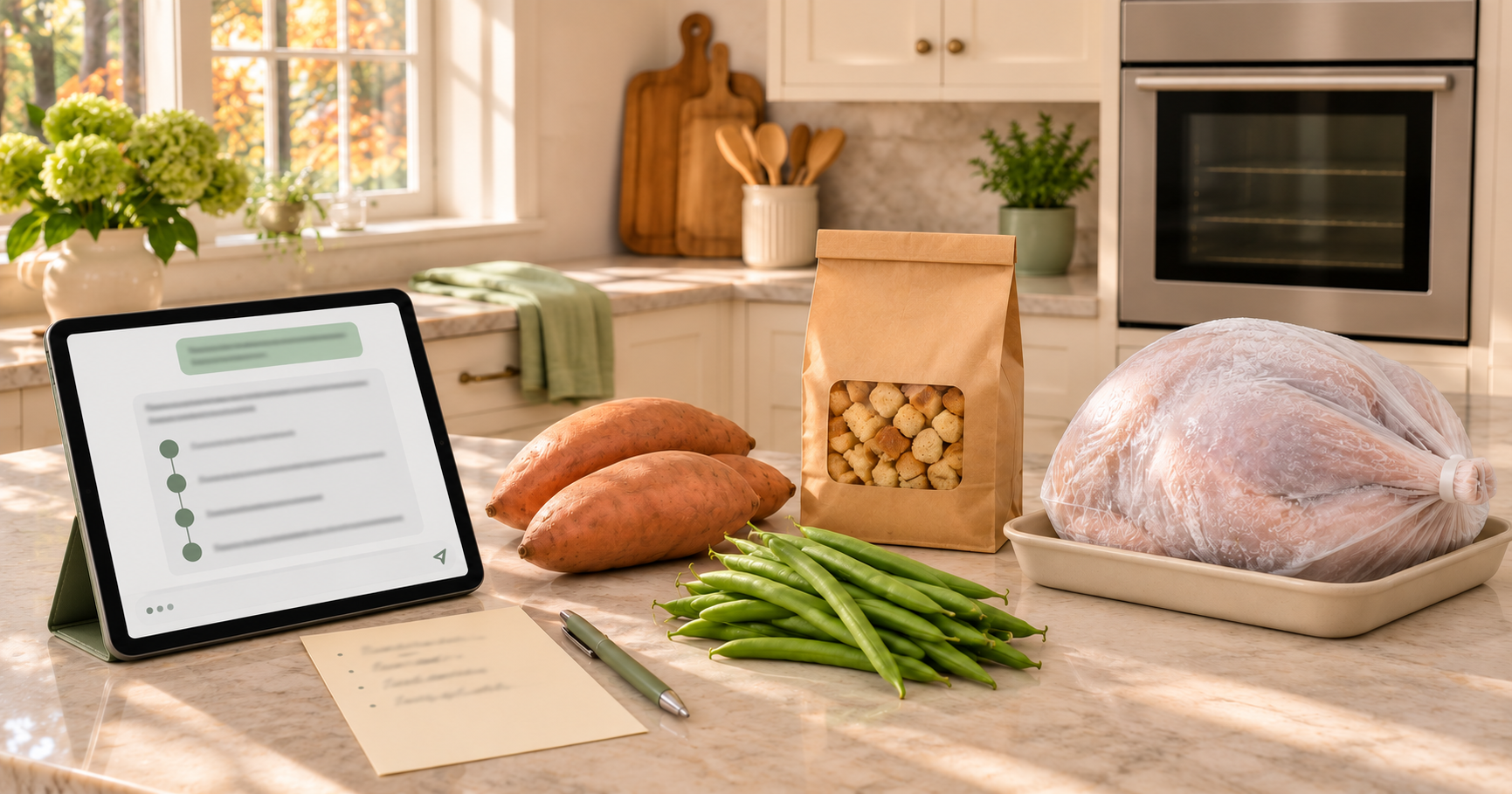
Here’s a made-up example. Say you’re hosting Thanksgiving dinner for eight, and this is what you know:
- Dinner is at 3 p.m.
- You have one oven and four stovetop burners.
- The turkey is 14 pounds and still frozen.
- The menu: turkey, stuffing, green beans, sweet potatoes, and a vegetarian main.
- One guest is vegetarian, and one has a tree-nut allergy.
- Your sister is bringing rolls.
- You have about $80 left for groceries you still need.
That list is your kitchen brief. It’s a short rundown of what ChatGPT needs to know about your kitchen, your guests, and your budget, so the plan it gives you fits your house instead of some generic holiday menu.
Also notice what’s not on the list. There are no last names, no addresses, and no medical details. ChatGPT needs to know that one guest has a tree-nut allergy. It doesn’t need to know which guest.
Then you give ChatGPT the list and tell it exactly what you want back:
You: I’m hosting Thanksgiving dinner for 8 at 3 p.m. I have one oven and four burners. Here’s my menu, my guests’ needs, and what I have: [your list]. Work backward from 3 p.m. and give me a cooking timeline, a list of what I can make the day before, and a shopping list of only what I’m missing. If two dishes need the oven at the same time, tell me instead of hiding it.
Read the first plan the way you’d cook it
Here’s the kind of plan that might come back. Yours will be worded differently, of course. Before you read past it, see how many problems you can spot.
ChatGPT: Morning: prep the stuffing and the sweet potatoes. 11:00 a.m.: turkey into the oven at 325°F. 1:30 p.m.: stuffing into the oven at 350°F, and sweet potatoes with a candied pecan topping at 400°F. 2:15 p.m.: green beans on the stovetop. 2:30 p.m.: take the turkey out to rest. 3:00 p.m.: dinner is served.
It looks organized. Now picture yourself actually doing it.
- One oven, three temperatures. At 1:30, the turkey is still roasting at 325°F while the stuffing wants 350°F and the sweet potatoes want 400°F. You can’t do that with one oven.
- The turkey is frozen. The plan never mentions thawing. It just puts the turkey in the oven at 11 a.m. on Thanksgiving day.
- The pecans. One guest has a tree-nut allergy, and the plan put candied pecans on the sweet potatoes. Pecans are tree nuts, so those have to go.
- The vegetarian main disappeared. It never got a time slot at all.
None of these are wild mistakes. They’re the kind that look reasonable until you actually walk through the day. That’s why you read a plan like you’re the one cooking it, because you are.
Not everything in the plan is wrong, though. It works backward from 3 p.m., it gives the turkey time to rest before dinner, and it puts the green beans on the stovetop. Those parts are worth keeping.
Fix it by naming each problem
Here’s the main idea. ChatGPT can do the heavy lifting on the meal planning, but you’re still the one responsible for getting dinner on the table. So you give it the best directions you can, and you let it give you its best answer. Then you review that answer. Look for anything it missed, anything it overlooked, and anything that just came out wrong. And pay attention to any questions that come up for you. Once the pecans are out, for example, what goes on the sweet potatoes instead?
Then tell it what to keep, what to change, and why. You could just say “make it more realistic,” and that might fix some of this. But when you name each problem and explain why, ChatGPT knows exactly what needs fixing.
You: Keep the 3 p.m. timeline, the turkey resting before dinner, and the green beans on the stovetop. Four things need to change. I only have one oven, so schedule it one temperature at a time, and move anything you can to the stovetop or to Wednesday. The turkey is frozen, so add thawing to the plan with a start date. One guest has a tree-nut allergy, so no nuts anywhere, including toppings. Swap the candied pecans for a nut-free topping and tell me what you’d use. And the vegetarian main needs a time slot. Show the oven schedule as its own list.
What comes back should look more like a plan you could actually follow:
ChatGPT: Sunday: move the turkey from the freezer to the refrigerator to thaw. Wednesday: make the sweet potato casserole with a marshmallow topping instead of the pecans, make the vegetarian main, and trim the green beans. Thursday oven schedule: turkey first; while it rests, the stuffing and sweet potatoes go in together at one temperature. Stovetop: green beans, gravy, and reheating the vegetarian main. Shopping list: only what’s missing from your list.
That’s a lot better, but it doesn’t have to stop there. The marshmallow topping raises a new question. Were those marshmallows made somewhere they could come in contact with tree nuts? So ask:
You: Marshmallows sound good, but I need to make sure they weren’t made somewhere they could come in contact with tree nuts. How can I check that? And if I can’t confirm it, what’s another nut-free topping I could use?
ChatGPT can help you look into the brand’s allergen information. And if you can’t confirm the marshmallows are safe, you’ve still got options, like a brown sugar and oat crumble you make yourself. That’s usually how it goes. ChatGPT meal planning that really works takes a little back-and-forth. You keep asking and checking until every detail that matters is covered.
Then plan one fallback. That’s a backup you’ve already thought through, because something always runs long. In this example, if the oven falls behind, the vegetarian main can reheat on the stovetop instead of waiting for oven space.
Check what only you can check
ChatGPT meal planning can help you organize a holiday meal, but it can’t tell you your food is safe. That has to come from official food safety guidance and the actual packages in your kitchen.
For the turkey, FoodSafety.gov’s Meat and Poultry Roasting Charts say to “allow about 24 hours for every 4 to 5 pounds” when thawing in the refrigerator. Their chart lists 3 to 4 days for a 12 to 16 pound turkey. So for a Thursday dinner, a 14-pound bird belongs in the fridge by Sunday. The same page lists a minimum internal temperature of 165°F for turkey. Check that with a food thermometer, not the clock.
For the allergy, read the full ingredient list on every package that goes into a shared dish, every time. That includes the marshmallows. If you’re not sure about something, leave it out.
The same approach works all season
Thanksgiving is just the example. ChatGPT meal planning works the same way for a Christmas dinner, a cookie exchange, or a potluck where you’re bringing two dishes and only have one free evening to make them. Give it your real limits, read the plan like you’re cooking it, and point out what doesn’t fit.
If the “keep this, change that, here’s why” part sounds familiar, I wrote about it in my post on how to get better answers from ChatGPT. It’s the same skill, just applied to ChatGPT meal planning.
Where this comes from
If you want to take your ChatGPT meal planning further, ChatGPT for Everyday Life has a resource built for it. The Put It to Work Resource Guide includes ChatGPT in the Kitchen. It turns this into a reusable kitchen brief, walks through catching an ingredient that got used in two meals at once, and includes food safety checks with links to official sources. And the book’s planning chapter goes deeper on building around your real capacity, meaning the time and energy you actually have, and always keeping a fallback.
Clear your head before the big day
Your holiday-week list gets long fast. The meal is just one thing on it. There’s also the guest room, the gifts, the travel, and that conversation you’ve been putting off. My free guide, Clear the Clutter, helps you get all of it out of your head with ChatGPT and pick your next three to five steps.
Get the free Clear the Clutter guide before the holiday rush picks up.


