




15 Nov Why We Start Total Body Balance by Bouncing
Posted at 13:00h
in General News & Updates from Kevin Wallace & The NewLife Portal, Morning Activation Class, Movement, Our Wellness and Healing Services
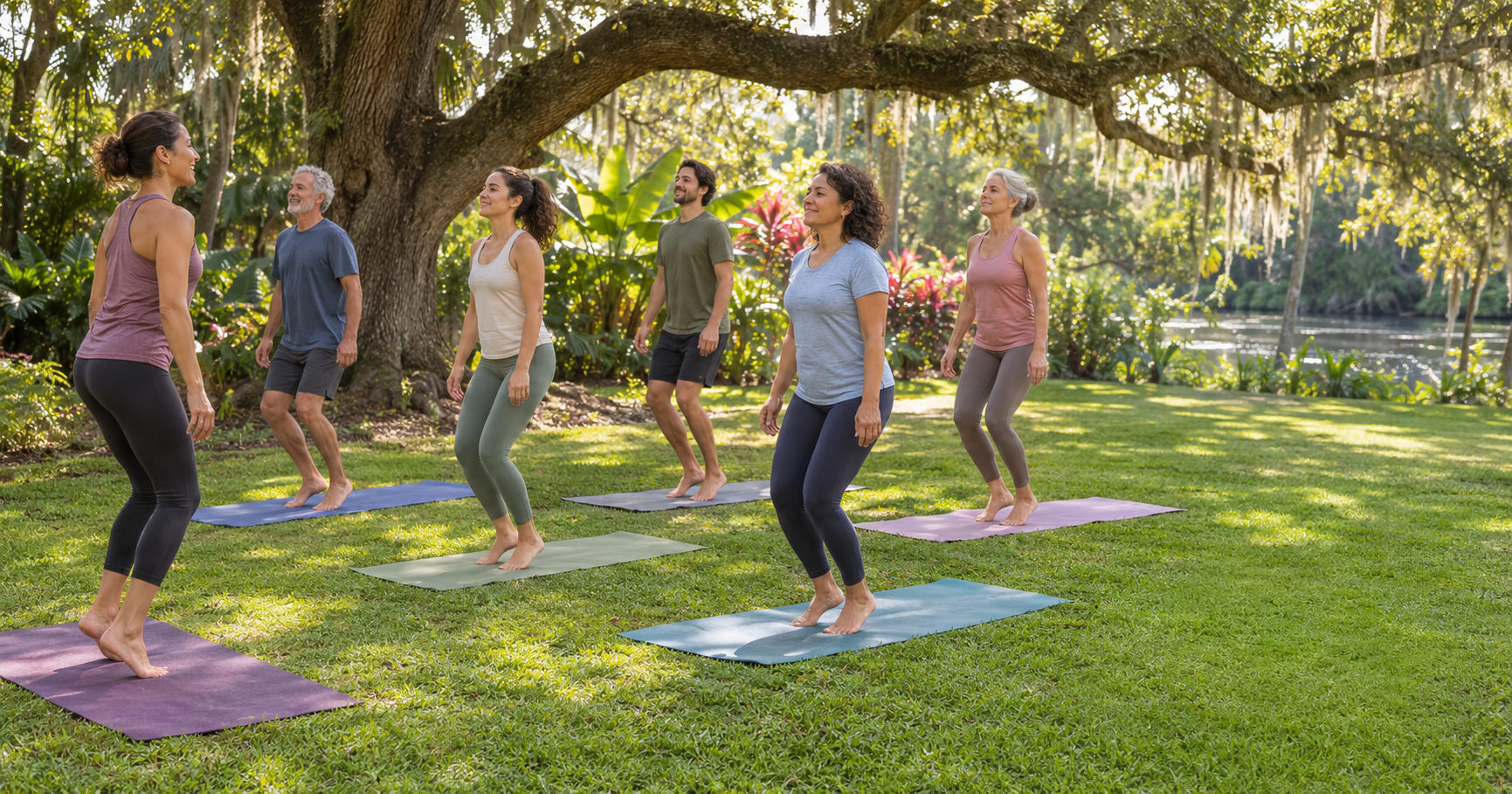
The first thing we do in Total Body Balance looks almost too simple to count as exercise. It’s a bouncing exercise.
There’s no equipment, no choreography, and nothing to memorize. For about a minute and a half, we stand and bounce. If you’re new to the class, you might wonder if this is really the warm-up. It is. It’s also more work than it looks like, and there are good reasons it comes first.
Before we bounce
I start every class by walking everybody through a few guidelines. They apply to the bounce the same way they apply to everything else we do.
The first one is about pain. Pain is a message from the body. It’s letting us know we’ve gone beyond what the body can currently do in that direction. So we honor and respect that message. But that doesn’t mean we quit the movement. We adjust it to a range that’s just outside the pain. Not far away from it, just outside of it. We want to be as close to the pain as we can without going into it. The idea is that, over time, the pain-free range slowly expands.
The second one is rest. If you’re getting worn out, take a rest, catch your breath, and get a drink of water whenever you need to. Nothing in this class requires you to do one movement so you can do the next one.
And if it’s your first class, especially if you haven’t exercised in a while, take it easy. See how you feel the next day and the days after. If you recover well, push a little more the next week, and a little more each week, until you find a good challenge without overdoing it.
Then we get started.
It starts at the shoulders
We start out with just the shoulders, up and down.
Once the shoulders are going, we start matching the knees. They bend and straighten along with the shoulders, so now you’re bouncing with the knees too.
If you’re comfortable with that and it’s pain-free, you can pick up the heels and bounce with the ankles as well. Now it’s all three together.
You don’t have to add every piece. If your bounce stays in the shoulders and knees today, you’re still doing the bouncing exercise.
Where the bouncing exercise comes from
Bouncing is part of Qi Gong. It goes along with arm swings and tapping on the body as a way to warm up before deeper work.
I’ve done it in yoga too. In online classes with my yoga school in Rishikesh, India, we used it as the warm-up, and we did it for five minutes straight.
I tell that story in class because five minutes of bouncing is actually quite a challenge. Think about what you’re doing. If you’re bouncing with the heels, a minute and a half is 30, 40, maybe 50 or 60 calf raises, with a mini squat at the knees every time. A lot of people are already feeling it by the time we stop.
So it’s a great warm-up, and five minutes is intense. That’s why I chose to keep it shorter, so it’s more accessible. A minute and a half gets the body warm and leaves you plenty for the rest of class.
Your calves are your second hearts
In Tai Chi, we refer to the calves as the second hearts of the body.
Your heart pushes blood down to your feet. Then that blood has to get back up, against gravity. Every time your calf muscles tighten, they squeeze the veins deep in your lower legs and push blood up toward the heart. Small valves in those veins keep it from sliding back down. That’s a big part of why walking is so good for your circulation.
When we bounce with the heels, the knee and the ankle bend together. That works the two main calf muscles, the gastrocnemius and the soleus. They tighten and release over and over. So you’re pumping your calves the whole time, and they’re helping pump the blood from your feet and legs back up toward your heart.
And it’s not just the blood. In Tai Chi and Chinese medicine, the legs and calves are a major pathway where key meridians run. Meridians are the channels that carry qi, the body’s energy, and they circulate qi and blood together. So in that tradition, pumping the calves keeps the qi moving right along with the blood.
Your lymphatic system needs you to move
Your lymphatic system is a network of vessels and nodes that carries fluid and waste out of your tissues. It’s also part of your immune system.
Your blood has the heart to move it. Your lymph doesn’t have a pump of its own. It moves when you move, as your muscles tighten and release around the vessels.
So with this bouncing exercise, we’re helping the lymphatic system. We’re working to enable it to do what it’s supposed to do.
Any movement helps with that. I’m not going to tell you bouncing is better than other exercise. It’s not worse either. It’s simple, it’s extremely low impact, and it’s an easy way to get a lot of benefit.
It’s also the first step in a sequence. After we bounce, we tap over the whole body. Then we go through a dynamic stretch routine that moves just about every muscle you have. Then we do an exercise that gets your heart pumping. Each step builds on the one before it. That’s a lot of movement, and it’s why I tell everybody to drink plenty of water. I’ll cover the tapping next week.
A starting point for stronger bones
If you’re bouncing with the heels and you’re feeling good with it, there’s one more option. You can start dropping the heel onto the ground and creating some concussion.
By concussion, I mean the impact of your heel striking the ground. That impact sends a shockwave up through the bones of the body. Your skeleton adapts to strain and challenge, just like your muscles and the rest of your soft tissues do. Put load on your bones and they build. Take the load away and they thin. It’s one reason athletes who lift heavy weights tend to have denser bones than the rest of us.
Researchers have tested this with women past menopause who had low bone mass. In one Australian trial, the women did supervised heavy lifting and impact training twice a week for eight months. Their bone density at the spine improved. The comparison group did light exercise at home, and they lost some.
A short round of heel drops is a long way from that program. I teach it as a starting point. Heel drops can lead to small hops. Hops can lead to jumps. For some people, jumps eventually lead to depth jumps, which is stepping off a low box and landing. Each stage asks a little more of your bones, and you only move on when the stage before it feels easy.
If you have osteoporosis or low bone density, or you’ve had a fracture, talk with your doctor before you add impact. You can always keep your heels on the ground and still get a great deal of the benefits from the bouncing work.
Why it comes first
This bouncing exercise is an easy way to get a lot of benefit. In about a minute and a half, your ankles, knees, and shoulders are warm. Your calves are pumping. Your lymph is moving. And if you did the heel drops, your bones got some impact to adapt to.
It still looks too simple to count. Try the bouncing exercise tomorrow morning for a minute and a half and see how you feel. Start with the shoulders, add the knees, and only add the heels if it’s comfortable and pain-free.
If you want to do it with a group, I teach Total Body Balance on Thursday mornings at Peace River Botanical & Sculpture Gardens in Punta Gorda. You can find the details on the Total Body Balance class page.
Sources
- Lymph has no pump and depends on movement: MD Anderson, How to improve your lymphatic system
- Calf muscles as the “second heart”: Biofeedback journal, Reactivate Your Second Heart, and Bass Medical Group
- Bone adapts to load: Radiopaedia, Wolff’s law
- The Australian trial (LIFTMOR, 101 postmenopausal women with low bone mass, 8 months, twice weekly): Journal of Bone and Mineral Research


