




22 Nov Body Tapping: How We Wake Up the Whole Body in Total Body Balance
Posted at 13:00h
in General News & Updates from Kevin Wallace & The NewLife Portal, Morning Activation Class, Movement, Our Wellness and Healing Services
Last week I wrote about how every Total Body Balance class starts with a bouncing exercise. Once the bounce is done, we go straight into body tapping.
It’s simple. You tap on your own body with your hands. But it wakes up your nervous system from head to toe, it gets qi moving the way Qi Gong teaches, and it helps your lymphatic system before we get into the rest of class.
Here’s what it does for you. Then I’ll walk you through exactly how we do it, so you can try it at home.
What body tapping does for you
Like most of this class, body tapping does a few things at once.
Every time your hand meets your body, it stimulates the nerves there, not just in the skin but down into the muscle underneath. That’s your peripheral nervous system, the network of nerves that runs out from your brain and spinal cord to the rest of your body. Tapping over the whole body is a great way to wake all of it up.
In Qi Gong and Chinese medicine, tapping over the meridians is a way to get qi, the body’s energy, moving through the body. Tapping has been part of Qi Gong practice for a very long time.
And it helps the lymphatic system. Your lymph doesn’t have a pump of its own, so it depends on you to move. Dr. Perry Nickelston, a chiropractor and the founder of Stop Chasing Pain, is my main teacher for tapping for the lymphatic system. He teaches tapping as a way to help lymph flow, which is why we spend extra time over the places where lymph nodes cluster: the base of the pelvis, the backs of the knees, the armpits, the collarbone, the neck, and the head.
Then the dynamic stretch routine that comes next moves just about every muscle you have, and the squat walkouts after that get your heart pumping and your lungs working. All that movement after the tapping helps wring out the lymphatic system, if you will.
How firmly we tap
We tap with an open, flat hand, as firmly as we can while still respecting the body. Some parts of the body are more sensitive than others, so we want to make sure we’re honoring that. If any of it starts to hurt, you’re tapping too hard. We want to tap as firmly as possible without any pain.
When we get up to the neck and head, which are usually more sensitive, we switch from the flat hand to the fingers. We bend all four fingers at the first knuckle and use them together like little paddles. When we work across the cheekbones, the bridge of the nose, and parts of the jaw, we even go up onto our fingertips, like little hammers.
Where we start
We start at the top of the sternum, or breastbone, right below where the two sides of the collarbone meet. Dr. Perry calls this spot the main drain, and his Big 6 routine is the base of my tapping.
There’s a reason it’s called the main drain. Your lymph travels through vessels that come together into two main ducts. Both of them empty into large veins at the base of your neck, and that’s where lymph rejoins your blood. Those spots are called the termini. Dr. Perry teaches that you clear the drain first, then work outward.
What we do in class is my own adaptation. We tap over the whole body, not just the Big 6 points the way Dr. Perry teaches them, because we’re combining the benefits of several modalities into our tapping work. But we always start and finish at that main drain.
We tap there firmly, with the fingertips and thumb landing close to the termini on each side of the base of the neck. That’s usually about 15 or 20 taps. I don’t count. I go by feel.
Down the front, up the back
From there, both hands move to just below the collarbone, at the top of each chest muscle, and we work our way down the body, over the ribs and down over the abdomen. When the hands reach the top of the hips, we stack them in the middle of the belly and tap our way back up to the ribs. Then the hands spread out again, and we tap down each side of the belly button.
We continue onto the front of the hips. Here we go very slowly across the crease where the legs meet the pelvis, because there are lymph nodes along that line.
Then we tap down the front of the upper legs, past the knees, and down the shins. If you’re able, we go over the ankles and the tops of the feet, all the way out to the toes.
Coming back up, we go around the outside of the ankle to the back of the lower leg. When we reach the back of the knee, we go back and forth over that area for a while, tapping again and again as the hands shift position. The back of the knee is another major spot for the lymphatic system, the nervous system, and the meridians.
Then we tap up the back of the upper legs, over the glutes, and onto the lower back. When we get up to where the kidneys are, we wrap around from the back, through the sides, to the front of the abdomen. By then, most people’s arms are pretty worn out from the tapping, so we shake them out.
The arms: inside down, outside up
Now we move into some specifics, starting with the arms. Pick whichever arm you want to start with and raise it. With the other hand, tap just below the armpit, on the side of the ribs over the serratus anterior. That’s on the side, behind the chest muscle, not on the chest itself. Then we go back and forth over the armpit, the same way we did the backs of the knees. The armpit is another place where lymph nodes sit.
From the armpit, we tap down the inside of the upper arm, past the elbow, and down the inside of the forearm to the hand. Then we come back up the back of the hand, the outside of the forearm, and the outside of the upper arm, over the cap of the shoulder.
That direction follows Qi Gong. In that tradition, the yin meridians run down the inside of the arm toward the hand, and the yang meridians run back up the outside. Tapping down the inside and back up the outside follows that flow.
When we get to the hands, we clap. I usually tell everybody, “Give yourself a big round of applause for showing up for yourself today.” People smile, and it feels good, because it’s true. They decided to come to class, and they’re putting in the work.
On the second arm, I like to talk about clapping itself. It’s something we do naturally to show excitement and to applaud people. And when we clap, we’re hitting one of the highest concentrations of nerve endings in the entire body. In Chinese medicine, the hands are full of meridian points too. So every time we clap, we’re really exciting the nervous system. I think it’s interesting that something we all do without thinking about it affects the body that way.
At the top of the arm, we tap the traps (trapezius muscles), the muscles on top of the shoulder where they meet the neck. First we wiggle the arm while we tap, so those muscles are moving under the hand. Then we let the arm hang loose and tap on the relaxed muscle. From there, we tap back over the top of the shoulder and along the collarbone to the starting point. We follow the base of the neck, but we don’t tap on the neck here.
At the starting point, we take a deep breath while we keep tapping. We breathe in through the nose, expanding the ribs, and out through the mouth. Once the exhale is done, we stop. Then we do the other arm the same way.
The neck and head
Now we’re almost done. The neck and head are usually more sensitive than the rest of the body, so this is where the fingers become paddles.
We start at the base of the back of the neck, right at the traps, and work slowly up to the base of the skull. We pause there for a moment, tapping, then go up almost to the top of the head and come back down.
Then we move out across the back of the skull toward the ears. We tap behind the ears, above the ears, and in front of the ears on the jaw. If you’re comfortable, let your mouth hang open so the jaw muscles can fully relax. The jaw gets more time than the other spots. Then we tap under the ears, at the corner of the jaw, and go around again.
Next, the fingertips become little hammers. We tap across the cheekbones toward the nose and onto the bridge of the nose until the fingers meet, then back out toward the ears. We do that twice. Then we raise the elbows so the fingertips stack one on top of the other in front of the ear, and we walk them back and forth across the jaw muscles. We finish with a little more flat-finger tapping and work back around the ears.
The front of the neck
The last section is the front of the neck. We find the SCM, or sternocleidomastoid, if you like the Latin. It’s a fun word, and I like throwing it in. The name lists where the muscle attaches: the sternum, the clavicle (your collarbone), and the mastoid, the bump of bone behind your ear. It’s the long muscle you can feel pop out on the side of your neck when you turn your head.
With the thumb and first finger, we gently trace it from top to bottom and back, pressing a little into the muscle. We make five or six passes each way. Be careful never to press on the throat itself.
Then we tap along it. I describe the SCM like a railing we follow, running right down the middle of the tapping hand so the taps land evenly on both sides of it. We go down and up three times. On the fourth pass down, we keep going to the starting point and take a deep breath, in through the nose, filling the ribs, and out through the mouth. We keep tapping all the way to the end of the exhale.
Then we do the same thing on the other side. On the second side, we finish with three deep breaths while tapping the starting point. That’s the end of the tapping.
A few cautions
Tapping over the lymph node areas is a great practice as long as the nodes aren’t tender when you touch them or tap on them. If a node is tender or swollen, skip that spot and let your doctor know. The same goes for any swelling in an arm or a leg.
Never press on the throat when you work the front of the neck.
As with everything in class, tap as firmly as you can without pain.
And drink plenty of water, both during class and after. Your body uses water to make lymph and blood and to keep your joints lubricated, and we’re moving all of them.
Where I learned this
If you want to go deeper into the lymphatic side of body tapping, two people I’ve learned from are Dr. Perry Nickelston, whose Big 6 routine is the base of my tapping, and Dr. Caitlin Czezowski, a chiropractor and functional medicine practitioner who runs Doc Talks Detox. She teaches a pumping routine for seven lymph node areas called the Specific 7. You can find both of them online.
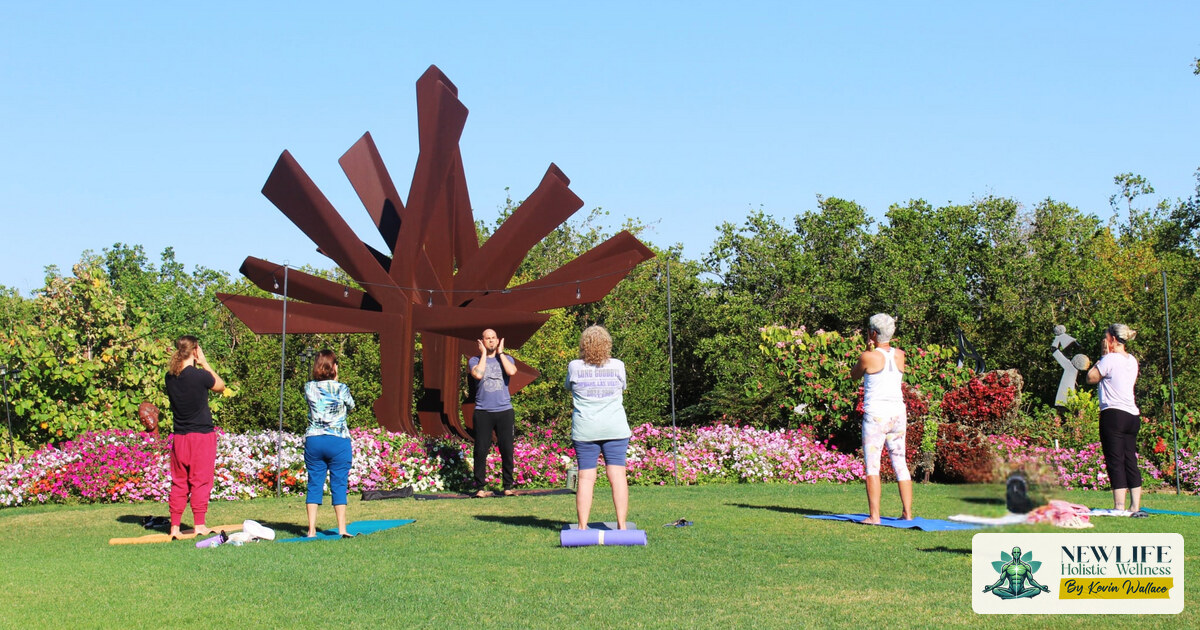
Next week, I’ll walk you through the dynamic stretch routine. If you’d like to try body tapping with me in person, I teach Total Body Balance on Thursday mornings at Peace River Botanical & Sculpture Gardens in Punta Gorda. You can find the details on the Total Body Balance class page.
Sources
- Lymph drains back into the blood through two ducts at the base of the neck: Cleveland Clinic, Thoracic Duct
- Dr. Perry Nickelston on the collarbone as the drain point and the Big 6: Less Stressed Life podcast, episode 319
- Where lymph nodes can be felt: British Association of Dermatologists, How to check your lymph nodes
- Fingertips have the most touch receptors: Michigan State University, Introduction to Neuroscience, “Touch: the skin”
- Yin meridians down the inside of the arm, yang up the outside: Flowing Zen, Making Sense of the Meridians
- Lymph has no pump and depends on movement: MD Anderson, How to improve your lymphatic system
- Water supports the making of lymph and keeps blood from thickening: Kaiser Permanente
- Water is part of the fluid that lubricates the joints: Tucson Orthopaedic Institute, Want Healthy Joints? Hydrate


