





25 Nov Your Family Health History: The Thanksgiving Conversation Worth Having
Posted at 13:00h
in 12 Weeks to a Happy Heart, Coaching, Diabetes Prevention and Long-Term Health, General News & Updates from Kevin Wallace & The NewLife Portal, NewLife Freedom Initiative, Our Wellness and Healing Services, Partners, Preventing Heart Disease, The Diabetes Reset: 12 Weeks to Balanced Blood Sugar, Understanding Diabetes, Understanding Heart Disease
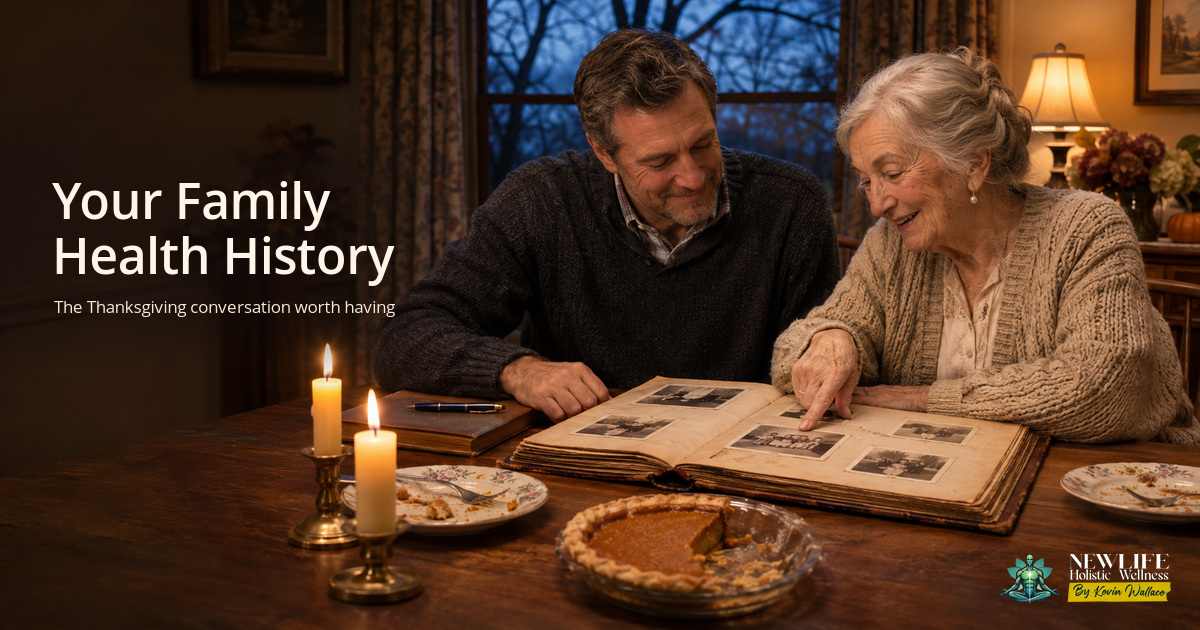
Tomorrow, a lot of us will be sitting around a table with family, passing plates and telling the same old stories. Somewhere in there, someone might bring up Grandpa’s heart attack, or mention that an aunt just started taking something for her blood sugar. It’s easy to let comments like that go by. But they’re part of your family health history, and knowing it can help you and your doctor decide what to watch for and when to start checking.
Since 2004, the U.S. Surgeon General has called Thanksgiving National Family History Day. The idea is that when families get together, they talk about the health problems that run in the family, and they write them down.
If blood sugar or heart health has been on your mind, a conversation about your family health history might be one of the most useful conversations you have all holiday season. So let’s go through why it matters, what to ask, how to bring it up, and what to do with what you learn.
Why Your Family Health History Matters
The CDC puts it plainly: a family health history of a chronic disease makes you more likely to get that disease, and knowing about it only helps if you act on it. Two of the conditions where that’s especially true are type 2 diabetes and heart disease.
- Type 2 diabetes: according to the CDC, if your mother, father, brother, or sister has type 2 diabetes, you and your other family members could have prediabetes.
- Heart disease: the National Heart, Lung, and Blood Institute counts a family history of early heart disease as a risk factor you can’t control. “Early” means a father or brother diagnosed before age 55, or a mother or sister diagnosed before 65.
Those two conditions are closely connected. Dr. Brian Mowll, a certified diabetes care and education specialist and author of The ProFAST Diet, explains that the insulin resistance behind prediabetes and type 2 diabetes also feeds inflammation in the blood vessels and raises the risk of heart disease and stroke. (I wrote more about that link in Insulin Resistance and Heart Health.)
Now, this isn’t meant to scare anybody. The CDC is clear that a family health history doesn’t mean you’ll definitely get the disease. Dr. Mowll lists inherited factors as one of the things that feed insulin resistance, along with processed carbs, extra weight around the middle, stress, too little movement, and poor sleep. So your genes matter, but most of that list comes down to how you live day to day.
And families pass down more than genes. We pass down recipes, portion sizes, what a normal dinner looks like, how active our evenings are, and how we handle stress. If your family’s big into barbecue, and there’s fatty meat on the table most days and bacon at breakfast, that’s probably how you learned to eat too. So when heart disease shows up in more than one generation, the habits everyone shared can be part of the reason, right alongside the genes. The good news is that habits can change.
Questions to Ask Your Family This Thanksgiving
The CDC suggests starting with your close blood relatives on both sides of the family: parents, brothers and sisters, grandparents, aunts and uncles, and nieces and nephews. You don’t need to reach everyone this week. Start with whoever’s at the table.
For blood sugar and heart health, these are the questions that matter most:
- Has anyone been told they have type 2 diabetes or prediabetes?
- Has anyone had heart disease, a heart attack, or a stroke?
- Does anyone have high blood pressure or high cholesterol?
- How old were they when they found out? A rough age is fine. “Sometime in his forties” still helps.
- For relatives who have passed away, what did they die from, and how old were they?
The age makes a big difference. Heart disease that started at 80 means something very different for you than a heart attack at 50.
How to Bring It Up Without Making It Awkward
You don’t have to make an announcement over the turkey. Here are a few ways to make it easier:
- Pick your moment. One-on-one conversations usually go better than asking the whole table. Try it while you’re helping in the kitchen, taking a walk after dinner, or looking through old photos.
- Tell them why you’re asking. Something like, “I’m trying to take better care of my health, and I’d like to know what runs in our family,” lets people know where you’re coming from.
- Go first. Share what you know about your own health. It makes it easier for others to share theirs.
- Respect a no. Some people keep their health private. You can always come back to it another time.
- Write it down that night, while it’s still fresh.
If you were adopted or you aren’t in touch with your family, you’re not stuck. Share whatever you do know about your family health history with your doctor. Healthy habits and regular checkups matter either way.
What to Do With What You Learn
- Put it in one place. A note on your phone works. The CDC also lists My Family Health Portrait, a free online tool for recording your family health history and sharing it.
- Take it to your doctor. Share it at your next visit, and ask whether it changes which tests you need or how often you need them. That way, what you learned can help you prevent a problem or catch it early.
- Know your own numbers. Ask for your A1C or fasting blood sugar, your blood pressure, and your cholesterol. Last week’s post, What Your Prediabetes Numbers Mean, walks through the blood sugar ranges. If your LDL cholesterol is above 190 mg/dL, the CDC suggests asking your provider about checking for familial hypercholesterolemia, an inherited form of high cholesterol, especially if early heart disease or heart attacks run in your family.
- Share it back. Your family health history belongs to your brothers, sisters, kids, and cousins too. What you learn could be the reason someone else gets checked.
- Work on what you can change: food, movement, stress, and sleep. That’s where both of my coaching programs focus.
Where Coaching Comes In
Finding out what runs in your family is the easy part. Changing the habits you grew up with is harder, especially when they’re wrapped up in family meals, traditions, and comfort food. Most people already know they should eat better and move more. But knowing what to do doesn’t change a habit by itself. If it did, nobody would smoke, and nobody would drink too much. What’s hard is doing it consistently, in your own life, around your own schedule, with your own family at the table. That’s where coaching helps.
The Diabetes Reset is a 12-week program co-created by Dr. Brian Mowll, a certified diabetes care and education specialist and author of The ProFAST Diet, and Health Coach Institute, where I trained as a health coach. It’s for people with prediabetes or type 2 diabetes, and also for people who want to prevent it because it runs in their family. We meet one-on-one each week by phone or Zoom. We start with Dr. Mowll’s Root Cause Assessment, which looks at your health history and checkups along with food, movement, stress, and sleep. Then we build habits one practical step at a time, with your doctor involved the whole way.
12 Weeks to a Happy Heart is a 12-week program co-created by Dr. Steven Masley, author of The 30-Day Heart Tune-Up, and Health Coach Institute. It focuses on the everyday habits behind heart health: heart-supportive eating, regular movement, handling stress, and getting better sleep.
Both programs are proven systems, delivered by a professional coach with years of experience. Every week, you get support and accountability as you work through the changes, with practical action steps to take out of the session and into your life. Once you know what runs in your family, you know where to pay attention. The weekly work is where you start changing the habits you can control.
The NewLife Freedom Initiative
Through December 31, 2026, both The Diabetes Reset and 12 Weeks to a Happy Heart are part of the NewLife Freedom Initiative, my partnership with Selah Freedom. While the initiative runs, NewLife Holistic Wellness donates 25% of the revenue from those two programs and Total Transformation to Selah Freedom. On a $2,000 program, that’s $500 for their work.
Selah Freedom is a faith-based anti-human trafficking nonprofit based in Florida. Their mission is to protect children, end sex trafficking, and bring freedom to people who have been exploited. They carry out that mission through five programs: Prevention, Awareness, Outreach, Residential, and Consulting. That work includes helping young people recognize unsafe situations, educating communities, and giving adult survivors a safe place to rebuild their lives.
So right now, when you invest in your own health through either program, you’re also helping fund that work. You can read more on the NewLife Freedom Initiative page, or support Selah Freedom directly by making a donation or volunteering.
Your Next Step
Enjoy the meal tomorrow, and the people around it. If you can, ask a question or two while you’re all together.
If what you learn has you wondering about your blood sugar or your heart, book a free 60-minute Discovery Session, and we’ll talk about where you are and which program fits. With the right plan, the right information, and the right support, you can make real progress, and I’d love to help you do it. You can also read more about The Diabetes Reset and 12 Weeks to a Happy Heart on their program pages.
Happy Thanksgiving!


